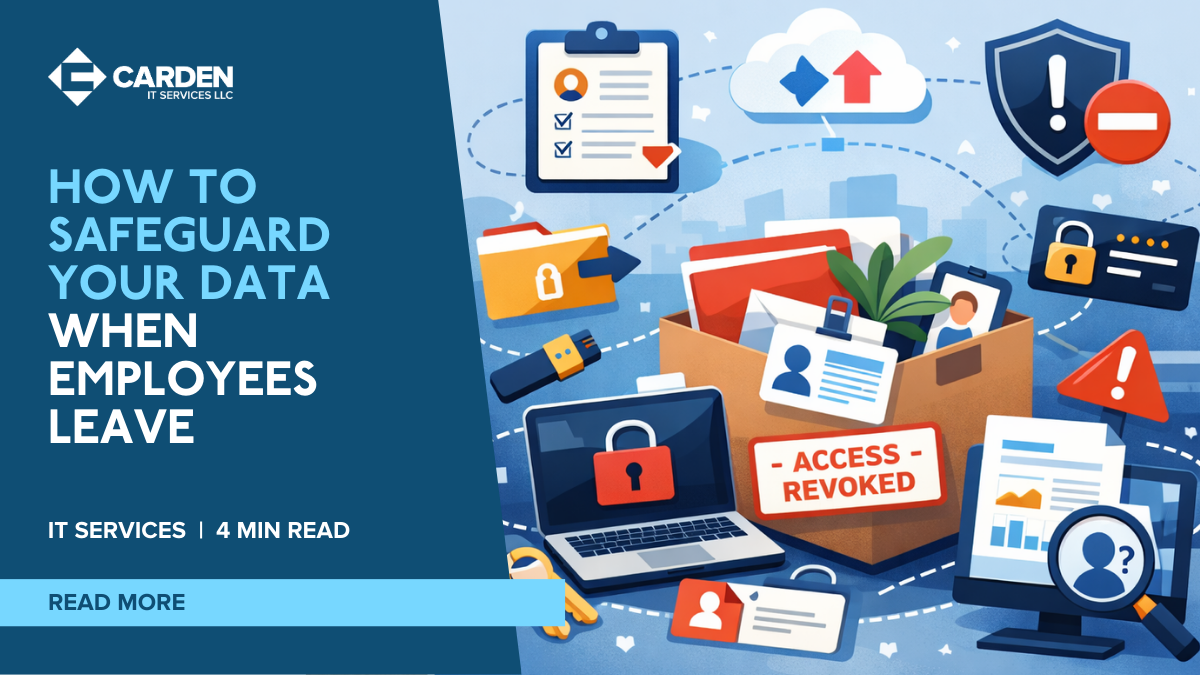
A strong offboarding process protects your data, reduces disruption, and helps your business stay in control of user accounts, devices, and information. This guide explains where data loss typically happens and the practical steps that prevent it. Carden IT Services supports businesses with structured offboarding, access control, and ongoing monitoring to reduce the risks that come with employee departures.
Why Data Loss Happens After Someone Leaves
Data does not only go missing because of malicious intent. In many cases, it is the result of incomplete admin work, unclear responsibilities, or data being stored in places the business does not manage. That said, deliberate data theft can happen, especially if a departure is difficult or unexpected. Knowing the common weak points makes it much easier to close the gaps.
Accounts are not disabled quickly enough
If email, cloud logins, or business applications stay active, a former employee may still have access to confidential information. Even a short delay can be enough for data to be copied, deleted, or shared. Carden IT Services can centralise this with a defined process and automated account deprovisioning.
Company data is still on personal devices
In hybrid workplaces, staff often use personal laptops and mobiles. Without the right controls, business files can remain synced or stored locally for months. Carden IT Services can implement mobile device management and security policies to remove business data safely without disrupting personal data where appropriate.
Shared passwords create an immediate exposure
Shared logins are risky because they are not tied to a single person and cannot be revoked cleanly. If shared credentials are not changed immediately, access can continue long after a user has left. Carden IT Services can help move your business towards individual accounts with audit trails, plus secure password management tools.
Offboarding is informal or undocumented
When there is no written checklist, it is easy to forget systems that are used less often, such as industry portals, payroll platforms, VPN access, admin tools, marketing accounts, or third-party SaaS subscriptions. A single, consistent checklist prevents missed steps. Carden IT Services can create and automate an offboarding workflow suitable for SMEs.
Unusual file access happens before the final day
A common pattern is increased downloading or exporting in the days or weeks before departure, such as CRM exports, customer lists, pricing files, and document libraries. Carden IT Services can implement monitoring and logging to flag suspicious activity early.
Put a Proper Offboarding Process in Place
A reliable offboarding process is one of the most effective controls you can implement. It reduces mistakes, keeps access tidy, and ensures nothing depends on memory or a last-minute scramble.
Remove access as soon as employment ends
Email, file storage, line-of-business apps, remote access, and shared platforms should be disabled at the point employment ends, particularly for unexpected exits. Carden IT Services can automate this through identity and access management, reducing the chance of any account being overlooked.
Secure and verify company devices
All company-issued devices should be returned, checked, and assessed for business data. If a device is not returned, remote tools can lock it down and wipe business data. Carden IT Services can provide device auditing, remote wipe, and asset tracking to protect information even when equipment goes missing.
Reset any shared credentials immediately
If older systems still rely on shared passwords, they must be changed straight away. A better long-term option is removing shared logins entirely by moving to identity-based authentication. Carden IT Services can support that migration so offboarding becomes simpler and safer.
Access Controls That Make Offboarding Faster and Safer
The less access each user has, the less risk you face when they leave. Strong access control reduces the “blast radius” of a departing account and makes offboarding more predictable.
Use role-based access control (RBAC)
Permissions should be assigned by role, not by habit or convenience. RBAC makes it easier to remove access because you know exactly what each role includes. Carden IT Services can configure RBAC across Microsoft 365, cloud apps, and on-premises systems.
Require multi-factor authentication (MFA)
MFA significantly reduces the risk of account misuse, even if a password has been reused elsewhere or exposed in a breach. Carden IT Services can implement MFA policies that fit your business needs and improve account security across all users.
Centralise user and cloud management
When accounts, licences, and devices are managed in one place, it becomes far easier to remove access immediately, sign users out, and verify nothing is left behind. Carden IT Services can help set up central management and keep it maintained over time.
Protect Cloud Data During Offboarding
Cloud services often hold the most valuable business information, and access can persist through signed-in apps, cached sessions, and integrations. A proper cloud offboarding routine should include:
- Sign the user out everywhere: Force sign-out removes access even if the user was already logged in on a device you cannot physically access. Carden IT Services can include this in an automated offboarding routine.
- Transfer ownership of key files and folders: If important documents sit under the user’s ownership, you can lose control of them after offboarding. Ownership and access should be transferred to a manager or shared location. Carden IT Services can manage file and mailbox ownership changes across Microsoft 365 and other platforms.
- Remove tokens and connected apps: Third-party integrations can maintain access through tokens even after a password is changed. Reviewing and revoking these connections is essential. Carden IT Services can audit connected apps and remove risky integrations.
- Review logs for unusual behaviour: Audit logs can show exports, bulk downloads, mass deletions, or access to sensitive areas outside normal behaviour. Carden IT Services can provide monitoring and alerts so you catch risky activity quickly.
Training and Clear Expectations Reduce Offboarding Risk
The strongest controls are the ones staff understand and follow. Many offboarding issues start during employment, not just at the end.
Reduce accidental leakage
When staff understand where data should be stored and how to use cloud tools properly, they are less likely to save files to personal locations or create unmanaged copies. Carden IT Services delivers cybersecurity awareness training to help build safer habits.
Make offboarding requirements clear from day one
Employees should know what business data is, what must be returned, and what is not permitted when leaving, such as copying customer lists or forwarding documents to personal email. Carden IT Services can help produce straightforward policies that set expectations clearly.
Monitor Activity Before and After Departure
If someone intends to take data, it often happens shortly before they leave. Monitoring gives you the chance to act early.
Flag bulk downloads, exports, and deletions
Large transfers or mass changes can indicate an attempt to remove or conceal activity. Carden IT Services can implement monitoring that raises alerts when these behaviours occur.
Alert on suspicious logins
Unexpected locations, unknown devices, or unusual login times can be signs of credential misuse. Carden IT Services can configure automated alerts and conditional access rules where appropriate.
Detect access outside normal patterns
If a user starts accessing areas they have not touched before, it can indicate data harvesting. Carden IT Services can help deploy behavioural analytics to identify unusual patterns and reduce response time.
Build a Repeatable Offboarding Strategy That Protects Your Business
Ex-employee cybersecurity is not one single step. It is a repeatable strategy combining access control, device management, cloud governance, training, and monitoring. When those foundations are in place, staff departures stop being a high-risk moment and become a controlled, predictable process.
If you want to tighten your offboarding workflow, reduce the risk of data loss, and make account removal consistent across all systems, Carden IT Services can help. Get in touch with Carden IT Services for a consultation or a tailored quote.