If a convincing email or friendly phone call asked your team to “confirm a login” or “approve a payment,” would they spot the warning signs?
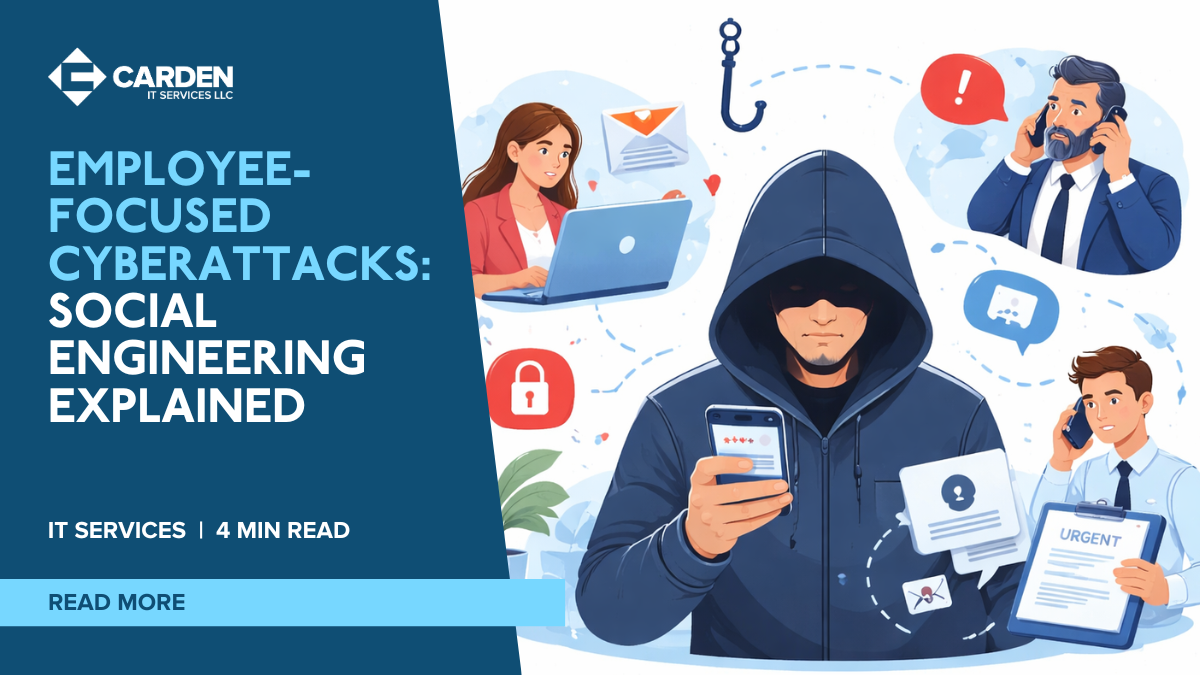
Many high-impact security incidents do not start with complex malware or advanced exploits. They begin with a simple act of persuasion. Social engineering relies on deception and pressure to get someone to hand over access, share sensitive information, or take an action that opens the door for a wider attack.
What social engineering means
Social engineering is a type of cyberattack where the attacker manipulates a member of staff rather than breaking into a system through purely technical methods. The goal is to trick someone into revealing confidential details, approving a request, or providing access they should not.
Attackers often pose as someone trusted, such as an executive, a coworker, a vendor, or IT support. They sound credible, and they create a sense of urgency to push the target into acting quickly instead of verifying first.
Why these attacks work so well
Even organizations with strong security tools remain exposed because humans still make day-to-day decisions. Attackers understand how businesses communicate and build scenarios that feel normal enough to slip through.
These scams tend to succeed because:
- The message sounds urgent, important, or “time sensitive.”
- Employees want to be helpful and avoid slowing work down.
- Remote communication makes it harder to confirm someone’s identity in person.
- Attackers may already know names, job titles, suppliers, or internal processes.
Who is most likely to be targeted
Any business can be targeted, but the risk often increases as teams grow. In larger organizations, people may not recognize every name or voice, which makes impersonation easier.
Hybrid and remote work can add risk as well, since more approvals and requests happen over email, chat, and phone rather than face-to-face conversations.
Common social engineering tactics
| Technique | How it typically works | Potential impact |
|---|---|---|
| Impersonation | Pretending to be a trusted person, such as an executive, coworker, or vendor | Account takeover, data exposure, fraudulent payments |
| Phishing emails | Emails designed to get someone to click a link, open an attachment, or enter credentials | Credential theft, malware infection, access to business systems |
| Vishing (phone phishing) | Phone calls that pressure employees to share information or authentication codes | Unauthorized access, password resets, compromised accounts |
| Pretexting | Using a believable story to justify an unusual request | Loss of sensitive data, financial loss, compliance issues |
How social engineering gets past technical security
Firewalls, antivirus tools, and email filtering matter, but they alone cannot prevent someone from sharing information if the request appears legitimate. Social engineering attacks aim to bypass technology by convincing a person to do the attacker’s work for them.
Once an attacker gets a foothold, they may move quickly, access additional systems, impersonate users, and expand the damage before the issue is detected.
How Carden IT Services helps reduce the risk of social engineering attacks
At Carden IT Services, reducing social engineering risk is an important part of our managed cyber defense approach. The goal is to make your people harder to trick, and your processes easier to verify under pressure.
We help businesses strengthen defenses through:
-
Security awareness training
Staff learn the most common tactics criminals use, such as urgency, authority, fear, curiosity, and “too good to be true” offers, so they can spot pressure tactics quickly. We provide clear, simple steps for what to do next, including how to pause, verify, and escalate safely. This builds confidence, reduces hesitation, and encourages staff to report suspicious activity early, which is often the difference between a close call and a costly incident. -
Phishing simulations
We run controlled, safe simulations that mirror the types of messages and approaches your business is likely to face. This helps identify where users, processes, or approvals might break down under realistic conditions. The point is not to catch people out. It is to learn what actually happens day-to-day, then tighten up the areas that are easiest to exploit, such as password resets, payment requests, invoice changes, and supplier bank detail updates. -
Clear reporting and practical next steps
You receive straightforward reporting that explains what happened, why it worked, and what to change, without blame or jargon. We turn findings into practical improvements such as stronger verification steps, better approval routes, and clearer “how we do things here” guidance for staff. This creates repeatable, auditable processes that hold up even when someone is busy, stressed, or working quickly.
Awareness is a security
Social engineering succeeds when someone feels rushed, unsure, or pressured to act immediately. A well-trained team, clear verification steps, and a culture that supports double-checking can dramatically reduce the chance of a successful attack.
If you want to lower the risk of human-targeted cyberattacks and strengthen your overall security posture, contact Carden IT Services to discuss security awareness training and managed cyber defense services.